Tuesday, November 27, 2012

Tombstone Tuesday - Aitchison

M. W. Aitchison
1911 - 1933

Martin Walter Aitchison was the son of William Robert and Caroline (Ulmer) Aitchison. He was born about 1911 in Canada. The family immigrated in 1915 and was enumerated on the 1920 census in Seattle, King County, Washington. Martin died on October 10, 1933. He is buried at Evergreen-Washelli Cemetery in Seattle.


Pin It

Saturday, November 24, 2012

A Little Saturday Night Genealogy Fun - Baby Name Wizard

Once again accepting Randy Seaver's challenge for Saturday night, I'm checking out my name, and others at Baby Name Wizard. It's always fun for me to try new things and share them, and I'm glad when it works out that I can participate.

These were the challenges:

1)  Go to the Baby Name Wizard site and see how popular your name was over the 20th century, and how popular a baby name it is today.  Check out your spouse, your children and your grandchildren (if you have some!) also. 

2)  What does your name mean (find out on http://www.babynamewizard.com/baby-name)?


3)  Tell us about it, and show us your graphs, in your own blog post, in a comment to this post, in a Facbook status or a Google+ Stream post.  

Here are my results:

1) I did two spellings of my name, both Joleen and Jolene (which enjoyed more popularity). Here is the graph, also including the name Jolette.


You can see that my spelling had its peak in the 1950s, when it ranked #880. You can probably guess I haven't met many during my lifetime who share this spelling. It's interesting that Jolene was much more widely used, and enjoyed a brief comeback in 2009-2010. 

My husband's name is Robert. His name peaked in popularity in the 1930s. He, however, was born in 1953 when his name was still very popular, ranking at #3. It still ranks #61. The graph includes the names Robin and Roberto.
 
We have nine children and lots (I mean LOTS) of grandchildren, so I'm not going to try to enumerate all of their names here with their ranking results. I love looking their names up, though.

2) Apparently, according to this particular site, Joleen has no meaning or origin. I think that gives me the liberty to be anything I wish! My mom told me she named me after the young woman who was the girls' club president at her high school. She thought she was a very kind person, so I've always felt some desire to live up to that reputation. ;)  (According to another site, Joleen is a form of Jolene which appears to be the name Jo or Joe with the feminine -lene suffix attached.)

Origin of the name Robert:Introduced to England by the Normans, Robert is derived from the Old High German Hruodperht, a compound name composed of the elements hruod (fame) and perht (bright). The name was borne by Robert I (d. 1035), duke of Normandy and father of William the Conqueror, and by three kings of Scotland.

3) Done!

Thanks, Randy! I enjoy these challenges, and reading others' results, as well.

Pin It

Saturday, November 10, 2012

Washington Family History Expo 2012

The Washington Family History Expo hosted by the LDS Church was held at the Redmond Stake Center in (guess!) Redmond, Washington. This was their tenth, or eleventh, year (the welcoming host wasn't sure). It was well advertised, well organized, very well attended and free. This was my first time there, but I know many of the attendees were repeat customers; and many came relatively far distances. My mom and I went together, and met a cousin and her mom. We all took different classes, but had the chance to visit during the lunch break and at the end.

The keynote address speaker was Norman J. Landerman-Moore. He has an impressive work history, including serving with Gov. Ronald Reagan. He is a compelling speaker and told short stories from his own family history, emphasizing the importance and potential impact of what he called "little stories." Discovering even brief records about our ancestors' lives makes them more real to us and can help us feel more connected to them.

Thereafter, there were eight or nine class offerings for each of the five one-hour periods with a 45-minute break for lunch. Lunch, for many of us, was a pre-ordered sack lunch, the proceeds from which will help young women of the area attend camp in the summertime. Some of those young women were our servers and the clean-up crew. Very pleasant.

My first class was called "Genealogy Gems in U. S. Probate Records" taught by Janice Blackhurst. It was very informative and orderly. A couple of things I learned are: 1. about 10% of the people who died before 1900 left a will; 2. be sure to check anywhere an ancestor owned property for probate records, not just where they lived.

Next, an educator from The National Archives of Seattle, Carol Buswell, discussed the resources in the archives nationwide which are particularly useful to genealogists. She went through a long list with us and answered every question put to her. She illustrated how to search the archives online at www.archives.gov. But, she stressed that if we needed help, "ask an archivist."

After lunch, I attended a presentation made by Jake Gehring of FamilySearch. His was titled "Changes and Development at FamilySearch." I loved it! He explained what FamilySearch is and gave a brief overview of its history. He shared lots of data to illustrate the advances and changes over the last ten years. There are 698.9 million images, 1.99 billion records, 3.07 billion searchable names and 1,311 total collections hosted at FamilySearch. This session was chock-full of information. There may have been a secret or two that slipped out...

My last two classes were Parts 1 and 2 of "England Online" presented by Godfrey and Merry Ellis. This couple makes English research look possible, in a very fun way. (Godfrey started the day by waving an English flag when he was introduced.) They presented real examples from their own families as illustrations of the many, many types of records and resources available. They explained when and why certain types of records were, or weren't, kept. Definitely worth attending. Maybe I can find my grandpa's family, now.

Obviously, I couldn't take every class that was offered. Among those that I had to forego were: Using Newspapers for Family History Research, Reasonably Exhaustive Search Explained, Bagging a Live One: Connecting with Cousins You Never Knew You Had, Researching Your Swedish Ancestors, Who Are the Scots-Irish?, Organizing Your Materials and Stories and Germans from Russia. Just the tip of the presentation iceberg!

To add to all the excellent classes were about two dozen exhibitors, including American Historical Society of Germans from Russia, Daughters of the American Revolution, Daughters of the Utah Pioneers, FamilySearch, Fiske Library, Jewish Genealogy Society of Washington State, Legacy Interest Group, Northwest African American Museum, and Seattle Genealogical Society.

All in all, it was an excellent conference. And, the price was SO right. ;)

A big thank you to the organizers and exhibitors for a wonderful, motivating experience. All the chatter afterward was very positive. This is a local event worth planning to attend - every year. I know I'll be there next year.


Pin It

Sunday, November 4, 2012

One Man's Journey - Part XVI

{previous}

photo by Gary Hoyle (used with permission)
I’m sure I mentioned somewhere above that the farmers in the area had a hard time getting their produce to market because of long distances and slow transportation. Somewhere along the line, an electrified rail system was run from Caldwell into the dam area. This made it somewhat easier for us to go to town, but to haul produce it was a four to five mile trip to get the stuff to the rail head. When it was our only purpose to go to town, we would take the buckboard or shafted buggy, leave the horses tied to the hitch rail provided, and board the car. I should tell you at this point that the operators of the contraption spent a lot of their time hunting pheasant, rabbits, coyotes, as well as anything else they could eat or draw a bounty on. I know they spent some time removing sheep, cattle and other livestock from the railroad so they could proceed on their appointed rounds. Whenever we left the horses at the rail head, we planned to stay only a few hours, because the sun was hot and the horses needed water every few hours. I don’t recall that any produce was ever shipped from this rail head. It was still too far from our place.

Somewhere along the line, the railroad was changed and run into our valley in about the same area where we first entered the valley around the curve in the road, it then continued east to a point about one-and-a-half or two miles from our place. A grade was cleared through a section diagonally to about one-half mile from our place, but this part was never used. We were now able to ship by the carload without too much trouble providing we had a carload.


One incident, which I shall always remember, related to the railroad, occurred when Dad decided to take a pig to market to get some ready cash. This particular car was a double end arrangement – passengers and motorman on each end with a freight compartment in the center.

via Wikimedia Commons
Dad placed the pig, which weighed 150 to 200 pounds, in a substantial wooden crate built for this purpose. We hauled it to the rail head in a wagon pulled by a team of horses. Dad backed the wagon up to the larger sliding doors to the freight compartment and he and I unloaded the pig crate, placing it near one wall away from the doors of the compartment. And then, the ruckus started.

One of the operators, probably the conductor, approached Dad and informed him that he could not ship a live pig to market in their vehicle. Of course Dad refused this argument because he needed the money and this was the best and easiest way to get the pig to town. The conductor then contacted the motorman to get his help in handling the situation. The motorman didn’t help their cause in anyway and they then proceeded to return the crated pig to our wagon, which was still backed up to the freight doors. I was standing in the wagon close to the seat holding the reins in case the horses spooked at all the yelling going on. Suddenly, one of those guys literally flew out of the door, missed the wagon entirely and landed in the dirt alongside the rear wagon wheel. I jumped into the compartment to see what was going on. The other guy was setting on the floor against the far wall with his hands over the stomach area of his anatomy. Dad took his pig to town. I drove the team home and reported to Mama. I shall mention this railroad in future additions since from now on, it was part of our lives.

Race with the Coyote

I’ve been debating with myself when I should records this story. I promised you on previous pages that I would bring it up at a later date, but I’ve never been sure of the right time since it doesn’t relate to anything much at this point, and much of it is vague. It concerned a baseball game and I’ve wondered why Colonel wasn’t involved because he was quite interested in playing the game.

via Wikimedia Commons
This is the only time I can recall that we went to another school to play. In this case, it was the Deer Flat School about seven or eight miles northwest of our school. We were transported to the school on a wagon furnished by one of our neighbors. We played the game and returned to our valley in early dusk. I was let off the wagon about two to two-and-a-half miles from home. By the time I got to the section where the railroad bed had been cleared, it was dark and the coyotes began to sing. It must be remembered that this was sagebrush country and the coyotes were out in force. At this point, I was about one or one-and-a-half miles from home and was becoming frightened, so I began to run with those guys yapping, first to the right and then to the left 20 to 30 feet from me. When I got out of the sagebrush and onto the main road, they kind of gave up, but I didn’t stop. It was the first time in my life that I got my second wind. I could have run all night, I believe.

I couldn’t say a word for some time after I got home, just too scared I guess. I think I know now why other events seem so vague since they were all secondary to the run with the coyotes.

Things were beginning to change somewhat as we were starting to get a few things that would help ease the hard labor.

Uncle Andy’s Lamp

First I want to mention Uncle Andy’s lamp. As explained above, all we had was kerosene lanterns and lamps, and at best they gave a very dim light. The lamp that Uncle got was about twice the size of most lamps, and it had a double mantle in it. I have no idea what kind of fuel it burned, but I suspect it was gasoline. Gasoline was being used to some extent, but few people knew what it was and probably didn’t care. This lamp gave a brilliant white light and when placed on a center table, it could light up a room well enough to read almost anywhere. One trouble, the mantles were so delicate that if the lamp was moved or jarred, the mantles would break. Lots of people visited just to see that lamp. {In 1914, William Coleman launched the Coleman Company}

Washing Machine

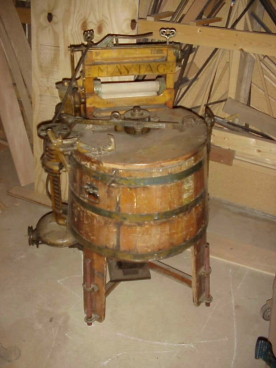
1911 Maytag

One of the first things Mama got to ease her labors was a washing machine. There was one thing Colonel and I found out real quick was that the contraption certainly wasn’t a labor saving device for us. It was made to run by advancing and withdrawing a wooden lever on the side of the tub. Operating this lever caused the rise and fall of three or four cups in the tub to push and then suck water and soap through clothing thereby eliminating soil, gravy and maybe cow manure from the fabric. The thing worked fine as long as there was just water in the tub, but when clothing was added a lot of opposition was placed on the muscle of young tender boys, but we fought it through and lived to tell about the rough life. The wringer was about as bad, but it sure helped Mama out a lot in her hard and busy life.

Kerosene Stove

As I told you, the summers were extremely hot, so Dad and Mama bought a kerosene burning stove. I believe it had three burners with a round wick. The stove didn’t have an oven, but it did have a warming oven, so any baking was don had to be done with the wood (coal) burning Home Comfort Range. The kerosene stove could be moved outside for better ventilation in the summertime.

Dad also acquired some labor-saving equipment. Some of this material was purchased in partnership with Mack Stocker, Uncle Andy and even Charlie Stephenson, whose place joined ours on the east. The manure spreader was an example of such equipment. Before we acquired this piece of equipment, the stuff had to be loaded onto a wagon by pitchfork. We usually used a four-tined fork for this purpose. When the load had been transported to a field it was again forked over the side and spread upon the ground. The spreader had a movable apron which the driver could operate from his seat at the front end of the load by engaging a number of gears, causing the apron to rotate toward the rear of the spreader. A rotating cylinder was also engaged, causing the material to practically fly out the back and spread evenly on the field. You got rid of the shoveling off but never the shoveling on. The potato planter, digger, sorter, wheat drill, and corn drill were other examples of community properties.

We had a couple of plows: one single bottom and one double bottom, a couple of mowing machines, a hay rake and two or three cultivators – one pulled by one horse and one pulled by two horses. This one could cultivate two or more rows.

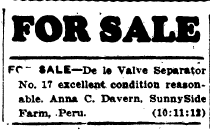
from 1937 Plattsburgh, Missouri paper
I think one of the best things we acquired was a cream separator. Before we got it, mild was poured into pans, set on shelving in the milk house. Then, it was allowed to stand until all the cream had risen to the top. Mama then skimmed it off into five or ten gallon milk cans. The skimmed milk was fed to the hogs. The De la Valve {Delaval} separator (trade name) saved a lot of labor and the end product could be kept cleaner and easier to handle. The hogs still got their share, but probably not so much cream in it. I believe the cream was picked up once a week by a butter making outfit in Caldwell.

The derrick was on our property, I believe, but was used by Mack and Uncle Andy because the dragging distance was not over one-half mile and four to six horses could handle it easily.

Besides the above equipment, we had the following rolling stock: the lumber wagon, drawn by two or more horses; buck board, drawn by two horses; two-seated hack with the fringe on top, drawn by two horses and a one-seated buggy with shafts; one horse harness for three teams and harness for buggy horse.

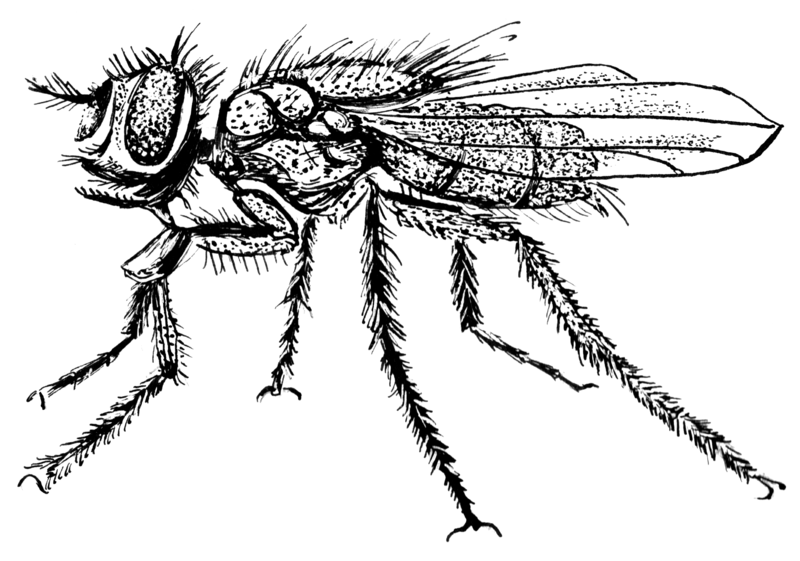
Flies

via Wikimedia Commons
We fought these insects about nine months out of the year. There was just no way we could exterminate enough of them to do much good. They would collect on the outside of the screen doors so thick that you couldn’t see through the screen, and at times, the inside of the house looked like the inside of a beehive. Mama got some paper that had a sticky substance on one side. This stuff was placed around. It caught a lot of flies, but didn’t make much of a dent in the population. Then, we had the black poison paper which was placed in a shallow plate or pan with water. The flies were attracted to the plates, drank the stuff and died by the thousands; but usually not before they took off, dropping dead in food and other places not healthy for us. The pans of this poisoned stuff also posed a problem for young children who are bound to eat and/or drink anything not good for them. I’m sure not just a few died from this concoction.


Before meals, especially when she was feeding a crew, Mama would have Colonel and me go to the corn field and pull several suckers from the main corn stocks. With these, we would drive many flies outside, but could not eliminate them entirely; so we continued to get them in our soup, coffee or whatever.

I know the above is a disgusting subject, but they were there. It did happen and I hate the things.

1916

The war in Europe was still in progress and was heating up to some extent. I know that Colonel and I worried some because we thought it possible that Dad may have to go if we became involved. At this point, we didn’t know too much about the situation over there; but some of the young men we had known earlier were prepared and were talking seriously about it.

I think it was about this time that Uncle Jim Youker showed up and stayed a few days. He was my mother’s only brother. We liked him very much because he had a lot of stories and was a sort of worldly individual. Mining had been his principal occupation from about the age of 12. That was the last time we saw him or received a word from him. Although Aunt Maude and Aunt Gertie spend considerable time and money in an endeavor to locate their brother, it has been assumed that he was in the service, but never returned. No Records exist. {I have found a record of James registering for the draft on September 12, 1918. He named his closest relative as being Mrs. Elizabeth Jackson (friend). He married Inez (probably Elizabeth, perhaps abbreviated Eliz and misread by the extractor) Jackson on September 25, 1918, in Payette, Idaho. If he served during the war, he survived because he and Elizabeth were living in Boise at the time the 1920 federal census was taken. Beyond that, I've found nothing.}

[I must explain that these people and perhaps other often changed their name. For what purposes I certainly don’t know. Mother’s name on her marriage certificate was Johnson. When we questioned her about this, she explained that her father changed his name to Johnson when he joined the Union army. Both Aunt Gertie and Aunt Maude had other names they went by at various times. So, it could be that James Youker did the same thing. I’m guessing here, something I vowed not to do in the preparation of this narrative. J.]

1917

We continued to do about the same things I’ve been telling you about. We ate, slept, worked and went to school in season. If I recall, the war in Europe didn’t seem to have much effect on the farmer. I know Dad raised lots of potatoes and wheat, but I can’t recall the dividends he may have received from this produce. Much of our produce was shipped to eastern markets and a lot of bad things happened on its way back there.

I believe it was May 1917 that the U S of A entered the war. {President Woodrow Wilson requested a declaration of war from Congress on April 2, 1917. On April 4th, Congress granted his request.}

I don’t know if Colonel or I noticed or knew that Mama was going to have a baby. I know mama didn’t feel well most of the time. The weather was extremely hot and she continued to do her usual chores. I don’t know if it was about this time or later that our doctor told us that Mama needed some rest.
{next}
to be continued ...


Pin It

A Little Saturday Night Genealogy Fun, on Sunday

Chicago, Illinois (1893)
Over at Genea-musings, Randy Seaver gave the challenge to play a form of ancestor name roulette. It sounded fun to me, and I have a few minutes to enjoy. Here are the results of my 'spin.'

  1. My great-grandmother, Maud May (Morgan) Bemiss, was born in 1884. Divide 1884 by 90 and get 20.93333..., rounded up to 21.
  2. Person number 21 on my ahnentafel is my third great-grandmother Grace Eliza Coryell.
    1. born on September 12, 1838, in Nichols, Tioga County, New York to Charles Patterson and Harriet Nancy (Field) Coryell. Charles was a physician.
    2. married on October 10, 1860, to Eugene Marguerat, probably in New York. Eugene was also a physician.
    3. died on March 6, 1915, in Chicago, Cook, Illinois.
    4. buried in Graceland Cemetery in Chicago
  3. Three facts about Grace:
    1. She attended the Moravian Seminary for Young Ladies in Bethlehem, Pennsylvania, in 1852.
    2.  Eugene and Grace moved to Chicago, Illinois, in 1862, where they were very active in civic and social activities. They had seven children:
    3. Grace was a member of the Daughters of the American Revolution, being a descendant of both Emanuel and John Coryell. John Coryell served with the Associators and when the British evacuated Philadelphia he supplied Washington with boats to cross the Delaware at Coryell's Ferry. Emanuel Coryell, while serving in the army, was wounded and received a pension of the rank of captain.
Very fun exercise!

Pin It